Credit Union Loan Participations: A Practical Growth Guide
Hypothetical scenario: A business member requests financing for an expansion. The lending team wants to support the relationship, and independent credit analysis supports the request. But the credit union already has meaningful exposure to the same industry, with other approved loans still awaiting funding. The CFO asks a different question: How much of this loan belongs on our balance sheet?
That is the right tension to resolve. A sound credit decision does not automatically make holding the entire loan the right portfolio decision.
NCUA’s Q2 2026 results provide context, not a lending instruction. A credit union loan participation decision should connect member need and independent underwriting with exposure, liquidity, agreement terms, and the ability to administer the relationship after closing.
Key Takeaways
- Systemwide growth and a modest delinquency increase are context—not a mandate to accelerate or stop lending.
- Establish the credit case independently before deciding whether to hold, buy, or share an exposure.
- Size the position against concentrations, liquidity, commitments, and contractual rights—not simply the amount available.
- Make servicing, ownership records, notices, monitoring, and exception resolution part of the approval decision.
Use the system data to sharpen questions, not set targets
In its Q2 2026 system performance release, published September 14, 2026, NCUA reported that total loans outstanding at federally insured credit unions increased by $82 billion, or 4.9% year over year, to $1.76 trillion. Delinquency was 96 basis points, up 6 basis points from a year earlier. The net charge-off ratio was 78 basis points, little changed compared with Q2 2025. ncua.gov
The delinquency movement is modest. These aggregate figures do not describe every institution, explain performance by loan type, or establish that loan growth caused delinquency to rise. They are not a forecast for the next loan presented to committee.
The practical response is to ask where your own institution has room to grow—and where another loan would add exposure you would rather not hold. Compare proposed lending with your own credit trends, funding outlook, and concentration appetite. Neither a systemwide growth rate nor a delinquency headline can settle that decision.
Establish the credit case before choosing the structure
Start with the borrower’s purpose, repayment capacity, and proposed terms. For an originated business loan, explain how the financing serves the member and what supports repayment under less favorable conditions. For a purchase, explain why this borrower and asset fit the credit union’s strategy, rather than beginning with the offered yield.
NCUA’s standing guidance on evaluating loan participation programs emphasizes independent underwriting: buyers should apply their own standards rather than rely on the seller’s or broker’s analysis. NCUA
Make that independence visible in the approval memo. Document the repayment assumptions your team tested, the information it challenged, and any policy exceptions requiring resolution. Evaluate the borrower’s overall obligations, not just whether the proposed participation amount looks manageable.
The seller’s corresponding discipline is to prepare a candid credit package, including weaknesses and material changes. Distribution should not become a reason to lower the standard of the original credit decision.
A participation structure should follow the credit case, not substitute for it. When the underlying request is unacceptable, sharing it is not a cure. Resizing, restructuring, deferring, or declining may be more appropriate than forcing a choice among hold, buy, and share.
Match the position to the constraint you actually face
Once the credit case is supportable, identify the limiting factor. Is it borrower exposure, concentration, funding capacity, contractual control, or staff capacity? Different constraints call for different decisions.

Hold when full exposure is a deliberate choice
Holding may be appropriate when the entire position fits policy, risk appetite, available funding, and the institution’s ability to monitor it. The case should explain why committing that capacity to this borrower makes sense alongside other member needs.
Look beyond the single-borrower amount. Test the proposed position against related borrowers, industry, collateral, geography, and existing commitments. Being below a limit is not, by itself, a reason to use the remaining capacity.
Compare the full hold with a lower-hold alternative. Explain which constraint would improve, what economics the institution would give up, and what additional administration sharing would require. This makes retaining the full loan an evaluated choice rather than the default outcome of origination.
Treasury should challenge the funding assumptions: What happens if committed loans draw before expected repayments arrive? How does holding this loan affect room for other approved lending? Assess the position through its expected life, not only on closing day.
Buy when the asset earns its place in the portfolio
For a buyer, available liquidity is a starting condition, not an investment thesis. Specify the portfolio purpose of the purchase and test whether the asset truly serves it. A different seller or geography should not be accepted as proof of diversification without examining the underlying repayment drivers.
A buyer’s liquidity assessment should cover future member demand as well as participation funding obligations, including unfunded commitments. NCUA
Translate that principle into a funding plan covering the initial purchase and subsequent draws. Evaluate maturity, repayment timing, and rate terms against the institution’s funding profile. Compare the economics after funding and administration costs, not just the coupon.
Information access is another constraint. Ask whether your credit team can obtain enough current borrower and collateral information to defend both the initial approval and later risk-rating decisions. An attractive price cannot compensate for an underwriting file your team cannot adequately evaluate.
Set the purchase amount from your own capacity analysis. Do not enlarge it simply because the seller has more available, or depend on an assumed future resale to make the position workable.
Share when the credit fits but full exposure does not
For a seller, sharing may be worth evaluating when the borrower’s request is supportable but the full exposure is not the preferred hold. Define the intended position and distribution conditions before promising a structure that depends on another institution.
Return to the hypothetical expansion loan. The credit union could evaluate a smaller hold alongside its industry exposure and pending commitments. A prospective buyer would separately evaluate the same borrower against its own policies, liquidity, and portfolio needs. Neither institution’s approval should substitute for the other’s.
If both cases work, the next question is whether acceptable agreements, funding arrangements, and servicing responsibilities can be established. If they cannot, reconsider the amount or timing rather than assume a buyer will appear.
Separate desired sale proceeds from funds available to meet a commitment. Test the period before distribution closes and any obligations that could remain under the agreement if a participant does not fund or declines a future renewal. The fallback needs to be workable, not merely documented.
Sharing does not make the borrower’s credit risk disappear. Exposure, funding obligations, and administrative duties need to be evaluated under the transaction’s structure and each institution’s role. NCUA
Make the agreement work when circumstances change
The agreement deserves attention before closing becomes urgent. It should address information sharing, approvals, loan modifications, and notices of adverse events. NCUA
Put those provisions through a practical test. When borrower financials deteriorate, who receives the information, how quickly, and who decides the response? When an amendment is requested, what consent is needed? How would the parties handle a disagreement over a workout or additional funding?
Counterparty review should be equally concrete. A buyer should assess the seller’s experience with the loan type and ability to deliver useful servicing information. A seller should assess whether the proposed participant can meet its commitments and work within the agreed decision process. A familiar institution still warrants transaction-specific diligence.
For the seller, distinguish any retained economic exposure from lender-of-record or servicing responsibilities. Do not infer the amount of credit risk retained simply from who communicates with the borrower. Have legal advisers identify the rights, duties, and exposure assigned by the proposed structure and agreement.
Likewise, ask accounting advisers to assess the actual transaction. Do not build the business case on assumed sale accounting, capital relief, or liquidity that the structure has not established.
Before approval, document the preferred position, the conditions that must be satisfied, and the fallback if the transaction cannot proceed as planned. Unresolved control or information-rights questions are reasons to pause, not administrative details to settle later.
Treat post-close readiness as part of approval
The operating question is not merely whether the institutions can close. It is whether they can administer the loan together through payments, advances, amendments, and problems. Ongoing monitoring and cash-flow controls belong in the participation program, not just the closing file. NCUA
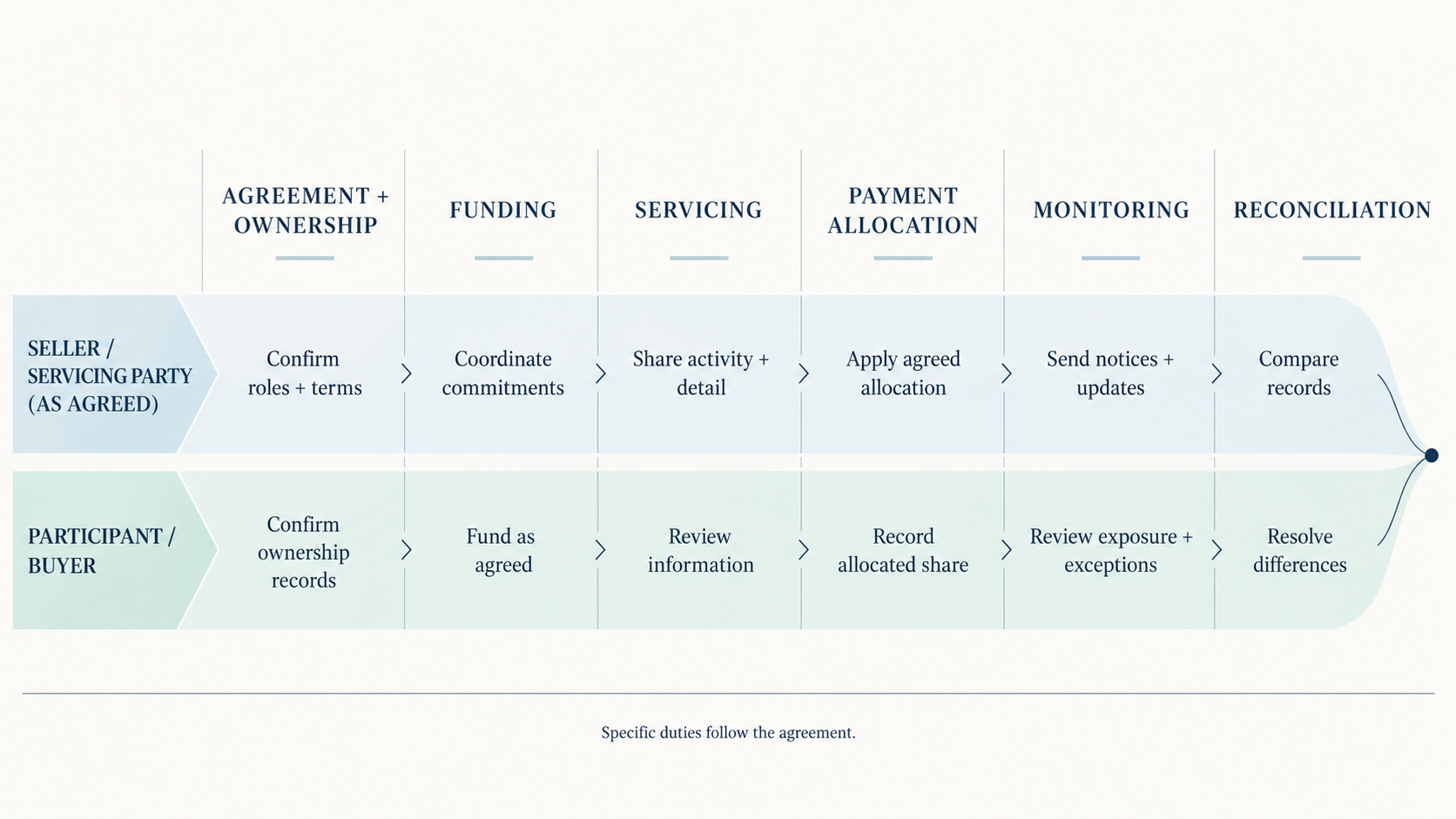
Before funding, have operations walk the approved agreement through the proposed workflow. Confirm the ownership record and effective dates, the funding responsibilities, the payment-allocation method, and the information each institution will receive. Designate who handles notices and who resolves differences.
Keep the two sides distinct. The party assigned servicing duties needs a workable process for communicating activity and supplying supporting detail. The buyer needs its own process for reviewing that information, maintaining its records, and escalating missing or inconsistent reporting. Receiving a statement is not the same as completing oversight.
A useful readiness test is to trace a payment from the underlying borrower activity through the agreed allocation to each institution’s records. Then test a changed rate, a reversal, or a missing notice. The ownership and reconciliation workflow matters because the team needs to explain differences, not merely make balances match.
As activity grows, revisit capacity alongside credit exposure. Set review triggers for overdue financial information, unresolved servicing exceptions, changed commitments, or deterioration in the borrower or counterparty. Assign an owner and an escalation path; do not leave the response dependent on informal relationships.
For teams formalizing this operating process, explore Participate, a BankLabs company and the Loan Sales Ecosystem for financial institutions, as an option supporting loan distribution workflows and post-sale participant servicing. The credit union remains responsible for its policies, independent due diligence, underwriting, decisions, agreements, ongoing monitoring, and obtaining transaction-specific legal and accounting advice.
The enduring question is not whether loan participations are good for growth. It is whether this credit, in this amount, under these terms, belongs in this institution’s portfolio—and whether the team is ready to manage it after closing.