Loan Participation Software: What Banks Should Evaluate Before Automating Shared Loans
A shared loan was boarded correctly, but a later borrower payment arrives with principal, interest, and a fee. The lead institution has the borrower transaction; the participant needs remittance detail; accounting needs an explainable posting and balance movement. Their systems and cutoff times differ, but their records must tell a consistent story.
This is where loan participation software should be tested. The question is not whether the original placement looked orderly. It is whether staff can follow the agreement, ownership, cash, and approvals through the new event without reconstructing the answer from spreadsheets, notices, inboxes, and memory.
Community and regional banks and credit unions should bring lending, operations, accounting, and integration stakeholders into this evaluation; each sees a different part of the same event.
Key Takeaways
- Evaluate software as a shared-loan lifecycle control and workflow layer, not only as a distribution or listing tool.
- Preserve approved ownership and effective dates, gross transaction components, allocation logic, remittance detail, balances, communications, and history.
- Reconciliation should surface and explain event-level exceptions without overwriting source history or hiding unresolved questions.
- Automation can standardize repeatable work but cannot replace accounting, credit, legal, tax, regulatory, policy, or professional judgment.
Start with the Lifecycle and Test the Shared-Loan Record
A loan participation is the sharing or selling of interests in a loan, as described by the OCC’s “Loan Sales and Participations”. The loan participation guide provides foundational educational context on participation structure.
Closing establishes the starting position; it does not settle later operations. Payments, rate changes, fees, reversals, prepayments, notices, and balance updates must remain consistent with the agreement and traceable across servicing, participant records, and accounting outputs. The buyer is evaluating that operating record, not merely the ability to list, distribute, or place a loan.
Before testing automation, establish what the platform knows about each individual loan. Its setup should connect the parties and roles, approved ownership shares and effective dates, funded balances, rate and fee terms, servicing responsibilities, and remittance instructions. Documents, permissions, and approval history belong with that record rather than depending on an employee knowing where to look.
Require field-level source ownership: identify which document or system supplies each field, who may amend it, and whose approval makes the change operative. A percentage without an effective date cannot establish which share applies to a payment. Ask the provider to retrieve the ownership version applicable to an earlier event, not simply display today’s percentage.
Also distinguish an approved change from a proposed one. A revised ownership schedule or remittance instruction should not become operational merely because someone uploaded a document. Ask how staff identify the governing version, document approval, and prevent an unapproved edit from becoming the basis of the next allocation.
The lead or servicer translates borrower events into participant activity. The participant needs enough detail to maintain its own records, compare the remittance, and conduct its own review. Do not treat shared servicing information as a transfer of the participant’s underwriting or credit responsibility.
OCC Bulletin 2020-81, “Credit Risk: Risk Management of Loan Purchase Activities”, includes participations within loan purchase activities. Its sound risk-management guidance addresses written transfer and servicing documentation, internal controls, reporting, audit, due diligence, assessment of accounting implications, and appropriate legal/accounting expertise. This is supervisory risk-management guidance, not a prescribed software design or institution-specific accounting advice.
The NCUA’s “Loan Participations” legal opinion makes a narrower point for the credit unions and rule at issue: each participated loan must be identified and treated independently, with servicing responsibilities and disclosures identified. Efficient payment netting still requires proper accounting of each loan’s individual status and consistency with the agreement.
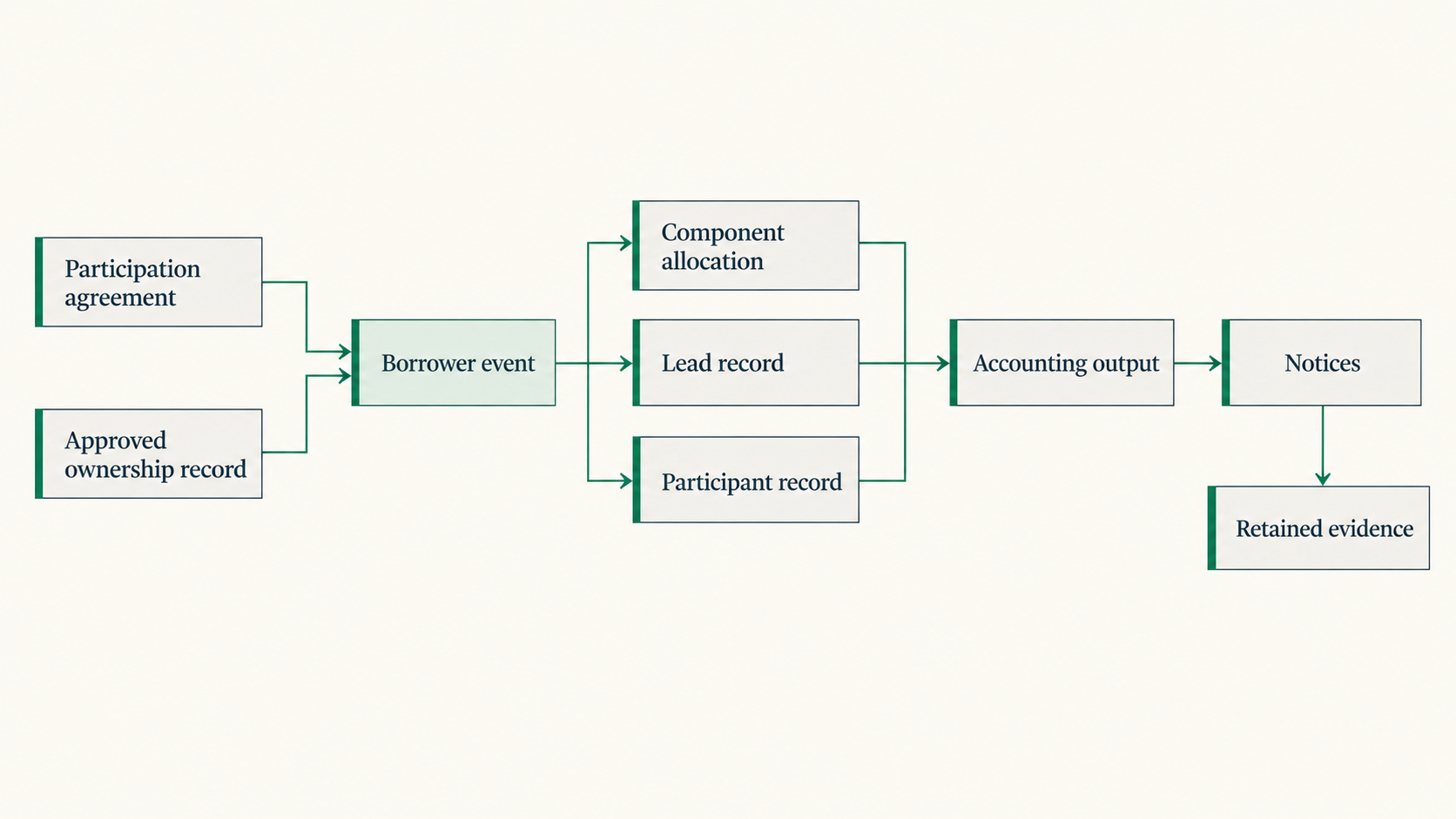
For the software evaluation, trace an approved ownership record forward to a borrower event, allocation, lead and participant records, accounting output, and notices, then backward to the supporting agreement. Identify where the platform maintains those connections and where staff must bridge a gap.
Follow One Payment from Source Event to Participant Record
Consider this illustrative, hypothetical example, not a customer result. A loan has a $10 million funded balance before payment. The lead institution retains 65%, and the participant owns 35%. The borrower pays $180,000: $100,000 principal, $70,000 interest, and a $10,000 fee. Solely for this illustration, the governing agreement allocates all three components pro rata, with no timing, accrual, rounding, or exception adjustments.
The participant’s share is 35% × $180,000 = $63,000: $35,000 of principal, $24,500 of interest, and $3,500 of the fee. The lead’s share is 65% × $180,000 = $117,000: $65,000 of principal, $45,500 of interest, and $6,500 of the fee.
Real agreements and institution-specific accounting treatment may differ. This example does not prescribe fee treatment.
| Control question | What the platform should show | What becomes risky when it is hidden |
|---|---|---|
| Which ownership and effective date apply? | The applicable approved share and effective date are visible. | A current share may distort an earlier event. |
| How are gross components allocated? | Principal, interest, and fees follow documented allocation terms. | A net amount may conceal a component difference. |
| What posted and changed balances? | Posted or exported amounts link to balance movements. | Cash allocation and recorded balances may diverge. |
| How was the exception resolved? | Evidence, owner, disposition, approval, and history remain linked. | An adjustment may mask an unresolved question. |
Start the demonstration with the source transaction and preserve its gross principal, interest, and fee classifications. Validate effective ownership before calculating shares. Then follow preparation, review, and approval into posting or export. The participant’s remittance detail should explain the allocation rather than present only a total. Trace the balance update to the principal component, compare the resulting records, and retain the source, calculation, approvals, and output as evidence. A calculated amount is not proof that the receiving system posted it.
Then change one condition. As illustrative operating tests, an effective-dated ownership change could leave two records using different shares; a rate reset could create inconsistent interest detail; and a late reversal could leave an earlier posting unmatched. A prepayment could leave participant balances out of step if its principal effect is not carried through. Agreement-specific fee treatment could invalidate a pro-rata fee assumption, while a cutoff timing difference could place corresponding records in different periods. A net-only participant posting could conceal otherwise explainable components.
These tests should reveal not just whether software calculates, but whether someone can explain the result. Ask staff to move from the participant’s record back to the borrower event without relying on a separate spreadsheet to supply missing allocation logic.
Evaluate Reconciliation by How It Handles Exceptions
A month-end balance comparison alone is late and incomplete. Agreement at the total level does not establish that every underlying allocation was correct. Waiting until then also leaves staff explaining events after additional activity has accumulated. Test event-level comparison alongside balance reconciliation, rather than treating one as a substitute for the other.
A reliable participation reconciliation should locate the specific event and compare the source or servicer record, participant remittance and participant record, and core or accounting output. It should compare gross components and effective ownership, identify the source of the difference, and assign someone responsibility for resolving it.
Distinguish the reason for the exception before choosing the response. A timing difference may reflect records captured at different cutoffs. A data or mapping error may place a valid amount in the wrong component or record. An unresolved agreement or policy question requires an authorized interpretation, not a balancing adjustment selected merely to clear the queue.
Technology can route all three, but it should not silently treat them as identical. Ask to see the supporting evidence, documented disposition, approval, and retained history. Where a correction is appropriate, the original record and its relationship to the correction should remain visible. Where a question remains open, the system should show that status rather than overwrite the uncertainty.
Test what makes an exception ready for closure. A timing item needs evidence of the corresponding event; a mapping correction needs a traceable corrected output; an agreement question needs the authorized decision attached. The platform should distinguish clearing an operational difference from deciding the accounting or contractual treatment behind it.
The NCUA’s “Evaluating Loan Participation Programs” discusses properly accounting for and controlling cash-flow streams and the importance of controls, reporting systems, servicing, monitoring, and agreement clarity. This is credit-union supervisory guidance, not a universal software mandate for every bank.

Test Participant Servicing, Reporting, and System Handoffs
Evaluate participant servicing from the receiving institution’s perspective. Ask whether participant-level statements and notices explain transaction components, balance movements, and rate updates. Can a reviewer reach the related agreement and documents from the transaction detail? Can the institution identify what was communicated, to whom, and which version supported the communication?
Permissions should reflect the parties’ roles and the institution’s approval process. Test document access and the distinction between viewing information, preparing changes, and approving them. Reporting should let operations investigate individual activity while giving accounting and lending leaders a consistent view of balances, outstanding questions, and servicing work.
For handoffs, examine exports or integration with the core, loan origination system, and accounting environment. Do not assume the participation platform should replace the core or accounting system of record. Establish how systems divide responsibility, who owns the data, which system controls each field, and how the exchanged records will be reconciled.
Have operations, accounting, and integration stakeholders follow an exchange together. Ask where duplicate entry remains, how cutoff differences are represented, and who investigates a failed exchange. Distinguish an export being produced from its receipt, acceptance, and posting. A retry should not leave staff uncertain whether the receiving system already recorded the event.
Include the participant’s review in the handoff test. A statement should not leave the recipient guessing whether an amount represents principal, interest, a fee, or a combination. Ask how a later correction reaches the participant and how the notice relates to the original transaction. Establish what evidence supports comparing what was sent with what the recipient recorded, even when the systems organize information differently.
An export may be an acceptable handoff when responsibilities, review, and comparison are clear. A more automated connection still needs those controls. Evaluate the work that remains after information moves, including rejected records and mismatched balances, rather than treating the existence of an integration as evidence that the lifecycle is controlled.
Confirm Auditability and Scalability Before Automating
Ask the provider to reconstruct an earlier event using the information approved at that time. Event history should connect versioned ownership and agreement data, preparation and approval roles, retained documents, notifications, and the resulting transactions. A current screen is insufficient when the review question concerns what changed, who authorized it, and why a prior result differed.
Searchable records should help a reviewer move between a loan, its participant activity, and related exceptions. Test whether a different employee can understand the evidence without the original preparer explaining it. This is a practical way to evaluate whether operating knowledge is retained in the workflow or remains with individual staff.
Assess scalability across more loans, participants, and pending events, not just through faster processing. Exception queues and reporting should expose aging, assigned owners, and recurring failure points. Ask whether repeated mapping issues or unresolved agreement questions remain visible to management after individual items are closed. More throughput is not a sufficient outcome when unresolved work becomes harder to see.
Have the team distinguish work that is calculated, awaiting approval, sent, posted, disputed, or closed. Those statuses should carry meaning across reports rather than collapse into a single “complete” label. Establish how staff identify the next required action and the person responsible without reopening every loan file.
Software can standardize repeatable workflow and surface differences, but it cannot decide institution-specific accounting treatment, interpret ambiguous agreements, approve credit, or replace legal, tax, regulatory, accounting, policy, or underwriting judgment.
This article is educational and is not accounting, tax, legal, or regulatory advice. Institutions should use qualified professionals for their specific facts, agreements, policies, and requirements.
The purchase decision should rest on whether the institution can trace an approved agreement through cash allocation, servicing, system handoffs, and retained evidence. Institutions evaluating a more connected approach can learn more about Participate.