The CDFI Secondary Market Needs Better Operating Structures, Not Just More Buyers
A CDFI can have a strong pipeline and still reach the point where the next well-underwritten loan will not fit on its balance sheet. Selling a portion of the portfolio can create room for additional lending. But if the transaction also separates the institution from day-to-day servicing and borrower communication, the CDFI may gain capacity at the cost of the context it uses to manage risk and support borrowers.
That is the central operating problem for the CDFI secondary market. The immediate constraint is not a lack of borrower demand. It is the lack of repeatable structures that bring in outside capital while preserving the relationship knowledge, servicing discretion, and accurate records that mission-driven lending requires.
The capital constraint is real—but demand is not the missing piece
A July 30, 2026 Federal Reserve Bank of Minneapolis analysis makes the tension unusually clear for Native CDFIs. In the survey comparison cited by the Bank, Native CDFIs were 25 percentage points more likely than non-Native CDFIs to report increased demand, 19 points more likely to expect increased demand, and 12 points less likely to say they could fully meet demand. These findings apply to the cited Native CDFI comparison; they should not be treated as universal statistics for every CDFI.
Capital scarcity is part of the explanation. The same analysis reports that 52 percent of surveyed Native CDFI loan funds identified scarcity of capital as one of their biggest challenges. It also cites one regional Native CDFI coalition whose report showed 468 percent asset growth and 558 percent portfolio growth from 2019 to 2025, with loan deployment rising from $4.6 million to more than $39.2 million and a reported default rate of 0.56 percent. That is one coalition’s experience, not an industry average, but it illustrates what can happen when lending capacity and community demand expand together.
The secondary market has not yet distributed that capacity broadly. Nearly 75 percent of CDFI loan volume sold on the secondary market in 2022 was originated by the 10 most active CDFIs by portfolio size. That concentration suggests that market access depends heavily on operating scale, standardization, and the ability to administer transactions after closing—not merely on the presence of qualified loans or potential buyers. For foundational context, see this overview of the secondary market for CDFI loans.
Why conventional secondary-market mechanics can be a poor fit
Traditional secondary-market structures often gain efficiency by placing daily administration with a third party. The Minneapolis Fed describes structures in which a third-party company manages pooled loans and notes that servicing rights may move to another servicer when a borrower defaults. Interviewees emphasized that this model can conflict with Native CDFIs’ direct, flexible approach to borrower support. The point is not that every loan sale transfers servicing, or that third-party servicing is always inappropriate. The point is that servicing design can change the lending model itself.
For a relationship lender, servicing is not only payment collection. It is where the institution sees early signs of stress, understands the borrower’s circumstances, applies approved flexibility, and decides when a routine exception requires credit attention. Removing that information from the originating CDFI can weaken both mission delivery and risk management.
Transaction structure therefore has to follow the operating objective. A loan participation can transfer a pro rata economic interest while allowing the originating institution to retain the borrower relationship and servicing role, subject to the governing agreement. A whole-loan sale transfers the full position and may produce a different borrower-contact and servicing model. Neither structure is automatically better; the right choice depends on how much exposure must move, which responsibilities must remain with the originator, and what information the buyer needs after closing.
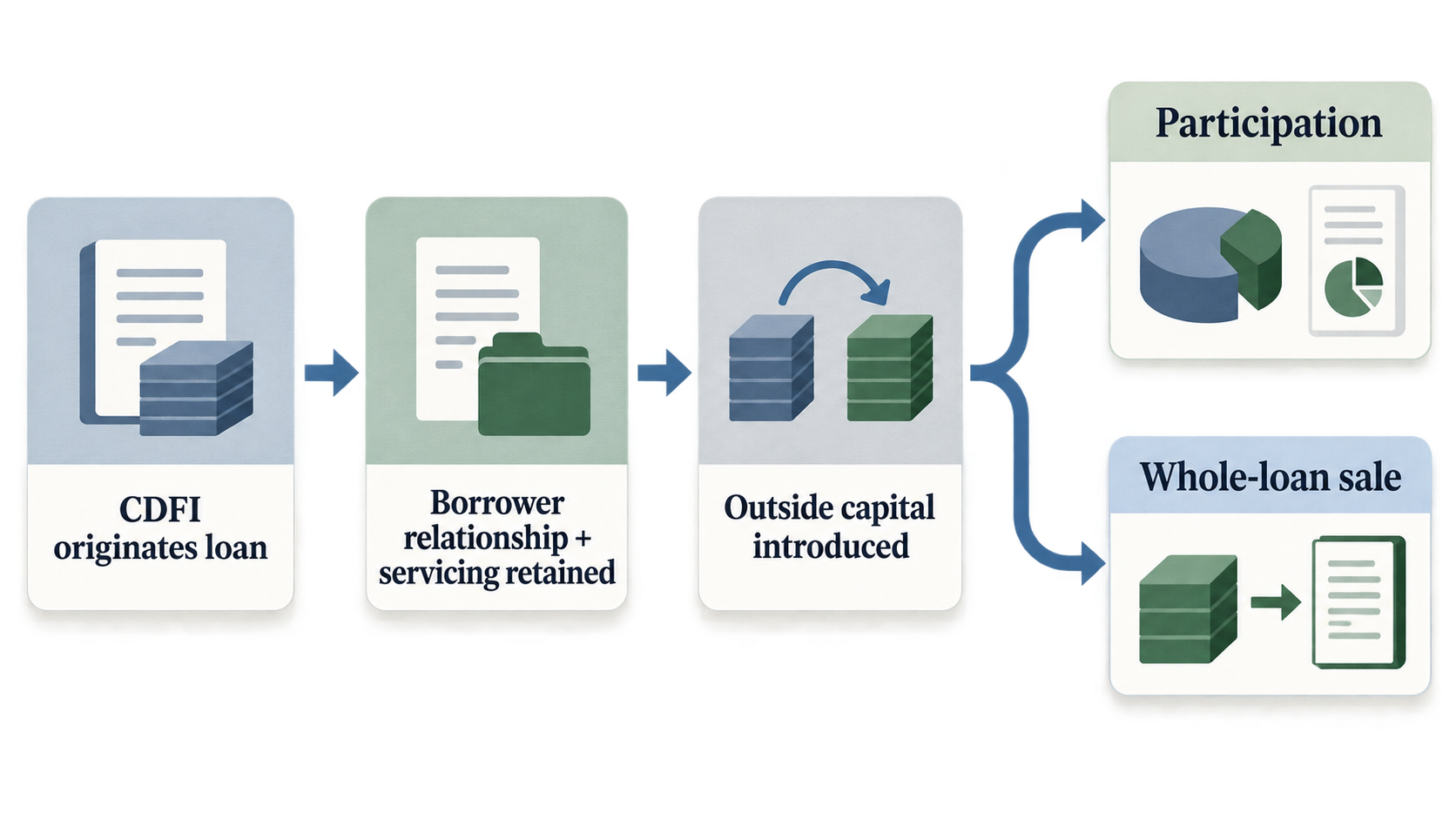
The operating design questions come before the transaction
A CDFI should define the post-close operating model before it markets a loan or invites a participant. Otherwise, the institution may complete a transaction that creates near-term liquidity but introduces recurring uncertainty in servicing, reporting, and exposure management.
Who owns the borrower relationship? The documents and workflow should identify the borrower’s primary point of contact, the circumstances in which a participant may communicate directly, and who is responsible for delivering notices or obtaining borrower consents. Ambiguity here can lead to conflicting messages precisely when the borrower needs a coordinated response.
Who services the loan, and where does discretion live? Retained servicing should be more than a label. The parties need a clear division of responsibility for routine administration, payment accommodations, modifications, delinquencies, workouts, and escalation. The CDFI should know which decisions remain within its authority, which require participant approval, and how time-sensitive exceptions will be documented.
How are payment and balance changes reconciled? Every borrower event must become an accurate participant event. Principal, interest, fees, advances, rate changes, reversals, and adjustments need a defined source record, effective date, allocation method, approval path, and exception process. If the originator and participant cannot trace a balance back to the underlying transaction, the shared-loan structure will create operational friction regardless of how well the credit performs.
How are documents and exceptions shared? Buyers need sufficient information for independent underwriting and ongoing monitoring, while the CDFI needs controlled access and a reliable record of what was delivered. The operating model should show who owns missing documents, covenant updates, expiring items, amendments, servicing exceptions, and resolution history. Email attachments and separate spreadsheets may work for one transaction; they become fragile as counterparties and loan volume grow.
How can the originator see retained and transferred exposure? The CDFI needs a current view of the gross loan balance, its retained hold, each transferred share, unfunded commitments, counterparty exposure, and relevant concentration dimensions. That visibility connects the transaction back to loan portfolio analysis and concentration monitoring rather than treating the sale as a one-time funding event.
Hypothetical operating scenario: Recycle capital, retain the relationship
This scenario is hypothetical and does not describe a customer or real institution.
A community-focused CDFI has more approved small-business demand than its available lending capital can support. It identifies a group of seasoned, performing loans that could support a participation transaction. The institution does not want to hand borrower communication or flexible servicing to an outside party because its staff members hold important knowledge about each business and community.
Before inviting buyers, the CDFI defines its retained exposure, servicing responsibilities, borrower-contact rules, participant approval rights, and the information that will be shared. The CDFI remains the primary servicer. Participating institutions receive a contractual economic share, controlled access to credit and servicing documents, and ongoing visibility into balances, transactions, payments, and rate changes. The originator retains a consolidated view of both its hold and the transferred interests.
When a borrower payment arrives, the event is recorded once, allocated according to the current ownership shares, reviewed under the agreed controls, and made visible to each institution. When an exception occurs, the supporting document, decision, and resulting balance change remain connected. Capital can be recycled into additional lending without turning the post-sale relationship into a chain of emails and manual reconciliations.
A whole-loan sale might still be the better answer for assets the CDFI no longer wants to service or retain. The operating lesson is the same: capacity comes from a repeatable transaction-and-servicing model, not from the legal label alone.
Participation or sale? Use the operating objective to choose
A CDFI can evaluate the structure in four steps:
-
Protect the non-negotiables. Identify which borrower-contact, servicing, modification, and community-accountability responsibilities must remain with the CDFI. These requirements should shape the transaction rather than being addressed after a buyer is selected.
-
Match the structure to the capital objective. A participation may fit when the institution wants to reduce exposure while retaining the relationship and a chosen hold. A whole-loan sale may fit when the institution wants to transfer the entire position. The expected balance-sheet effect should be evaluated with the transaction’s pricing, retained obligations, recourse, servicing economics, and accounting treatment in view.
-
Test the operating model under stress. Walk through a late payment, rate change, additional advance, document exception, amendment, and payoff. If the parties cannot identify who acts, who approves, which record controls, and how the change reaches every institution, the structure is not ready to scale.
-
Confirm governance and visibility. Management should be able to see what was sold, what remains, which counterparties hold interests, what exceptions are open, and how the activity affects concentrations and available lending capacity. Buyers should receive enough information to perform their own underwriting, monitoring, and administration.
This sequence keeps the decision grounded in operating consequences. It also prevents a CDFI from treating secondary-market access as a one-time capital event when the real commitment continues through the life of the loan.
What better shared-loan visibility enables
When the operating structure is sound, outside capital and relationship lending do not have to be opposing choices. The originator can retain the borrower context it needs. Participants can see their ownership, activity, and supporting documents. Operations teams can trace payments and changes without rebuilding the record from separate files. Management can connect each transaction to retained exposure and future lending capacity.
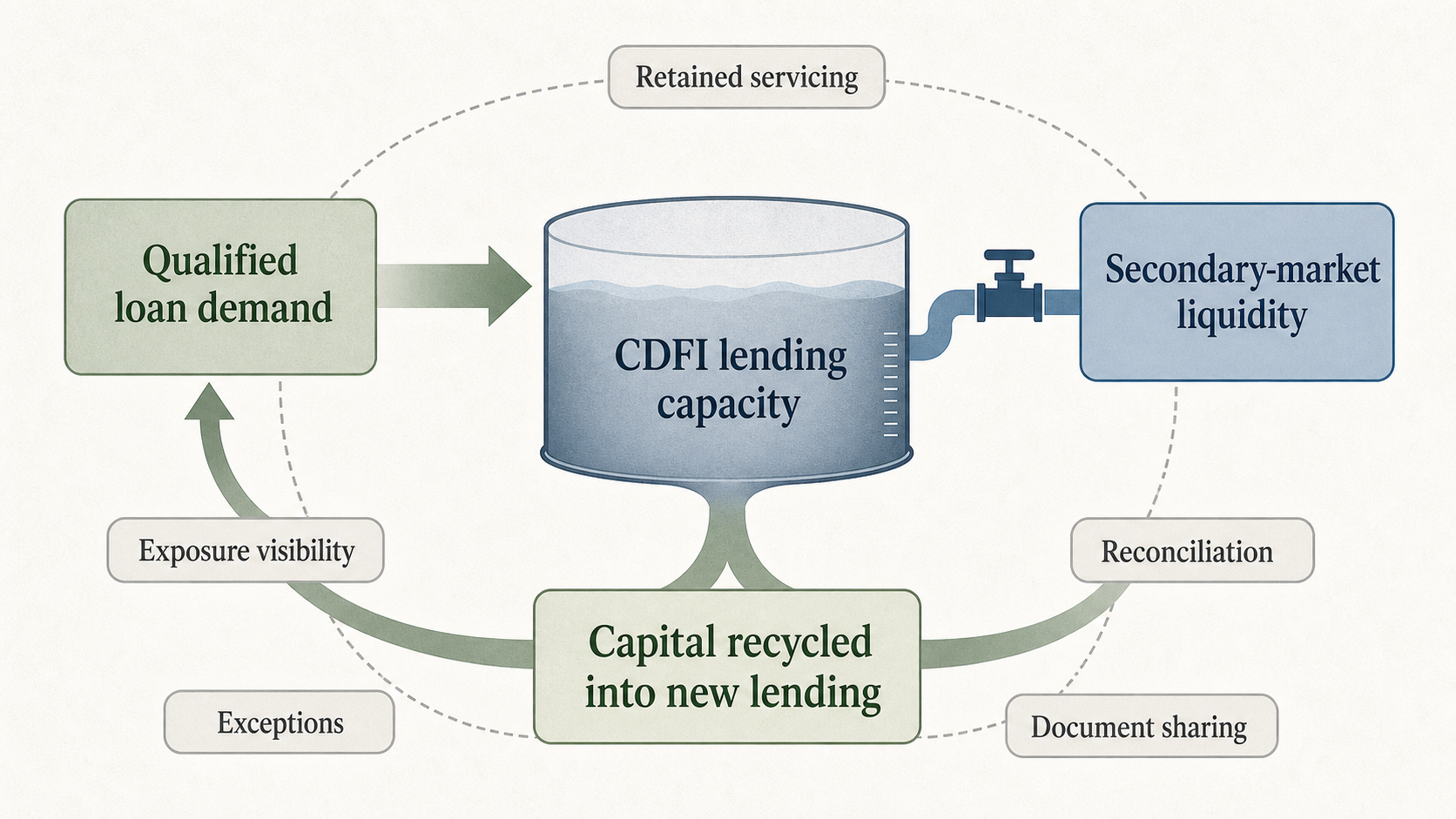
This is where a shared operating layer matters. Participate supports a shared system of record for loan details, documents, pro rata shares, transactions, balances, rate changes, and post-sale servicing workflows across loan participations, syndications, whole-loan sales, and other supported loan-sale structures. It gives originating and participating institutions aligned operational visibility; it does not replace underwriting, credit decisions, servicing judgment, accounting judgment, legal analysis, or regulatory compliance responsibilities.
A practical next step: Select one representative loan and map the full workflow from borrower approval through distribution, closing, payment allocation, document updates, exceptions, and payoff. Evaluate Participate against that operating map only after the institution has defined what it must retain, what it can transfer, and what every party must be able to see.
The CDFI secondary market will not broaden simply because more qualified loans exist. It will broaden when lenders can bring in outside capital without stripping away borrower knowledge, servicing control, and record accuracy. For mission-driven institutions, capital recycling and relationship lending have to be designed as one operating model.