Loan Participation Accounting: From Ownership Setup to Reconciliation
A participated loan can look straightforward when it closes. The agreement is signed, ownership percentages are approved, the loan is boarded, and the participant receives confirmation. The operational challenge often appears later.
Consider a borrower payment that arrives months after closing. The payment includes principal, interest, and a fee. The lead institution records the borrower activity in its servicing environment. The participant expects its share based on the participation agreement. Accounting needs the correct balances, operations needs the remittance detail, and both institutions need evidence showing how the final amounts were determined.
The payment itself is not the difficult part. The difficult part is ensuring that the participation agreement, ownership records, borrower transaction, allocation method, remittance, accounting records, participant communication, and supporting evidence all tell the same story.
Key Takeaways
- Loan participation accounting involves two connected responsibilities: reaching an institution-specific accounting conclusion based on applicable facts and maintaining the operating records that support ownership, cash flows, reporting, and audit evidence.
- Every participation event should connect approved ownership, effective dates, transaction components, payment allocation, remittance detail, posting activity, and retained documentation.
- Reconciliation is strongest when teams explain differences at the individual event level instead of waiting for unresolved items to become month-end balance problems.
- Software can organize records, automate workflows, and improve visibility, but it does not replace accounting judgment, legal analysis, tax considerations, regulatory interpretation, credit decisions, or institution policies.
This article is educational and is not accounting, tax, legal, or regulatory advice. Financial institutions should use qualified professionals for their specific agreements, facts, and requirements.
Loan participation accounting has two layers
The phrase “loan participation accounting” is often used to describe two related but distinct activities.
The first layer is the institution-specific accounting conclusion. A bank or credit union must evaluate its own transaction structure, agreements, policies, facts, and professional requirements to determine the appropriate accounting treatment. That conclusion belongs to the institution and its qualified advisors. A clean operational workflow does not automatically determine the accounting outcome.
The second layer is the operating discipline that supports the accounting process after closing. This includes maintaining accurate ownership records, tracking borrower activity, allocating cash flows, preparing participant statements, documenting changes, resolving differences, and preserving evidence.
A participation process can fail in either direction. Strong accounting analysis can still be weakened by incomplete ownership records, unclear servicing responsibilities, or missing transaction history. Conversely, a perfectly organized workflow can still require professional accounting judgment before an institution determines its reporting treatment.
The supervisory focus on this operating foundation is reflected in the Office of the Comptroller of the Currency’s guidance on loan sales and participations. The OCC describes a loan participation as the sharing or selling of interests in a loan and notes that institutions use participations for purposes such as liquidity, interest-rate-risk management, capital and earnings considerations, diversification, and borrower service. Loan Sales and Participations
The OCC’s Bulletin 2020-81 also emphasizes that sound loan-purchase risk management includes assessing accounting implications, using appropriate legal and accounting expertise, maintaining written transfer and servicing documentation, establishing internal controls, and ensuring appropriate reporting. OCC Bulletin 2020-81 The bulletin is supervisory risk-management guidance, not an institution-specific accounting conclusion.
The practical implication is simple: the journal entry depends on the quality of the event chain underneath it.
Establish the record before processing events
Participation reconciliation problems often begin before the first payment arrives. They begin when ownership, terms, responsibilities, and source records are not clearly established at boarding.
A reliable operating record should identify the individual loan, participating parties, lead institution role, participant role, approved ownership shares, retained share, effective dates, funded balances, commitments when relevant, rate and fee terms, servicing responsibilities, remittance instructions, authoritative source for each field, and approval history.
The lead institution typically acts as the operational bridge between borrower activity and participant activity. A borrower payment, amendment, rate change, or advance begins as an institutional event that must be translated into the participant’s economic share according to the governing agreement.
The participant has its own responsibility as well. A participant should maintain its own records, perform its own review, and compare received activity against its internal systems. Participation does not transfer underwriting responsibility or eliminate the participant’s need for independent credit and operational oversight.
For credit unions subject to the specific rule and facts addressed by NCUA’s legal opinion on loan participations, each participated loan must remain identifiable and treated independently, and efficient payment netting still requires proper accounting of each loan’s individual status and consistency with the agreement. NCUA Legal Opinion: Loan Participations The opinion should be applied within its stated context rather than generalized beyond the rule and facts involved.
The operating record is the bridge between the agreement and the accounting system. It should allow someone reviewing the transaction later to answer basic questions: Who owned what share? When did that ownership become effective? What transaction occurred? How was it allocated? Who approved the treatment? What evidence supports the conclusion?
Follow the payment from borrower event to participant record
A simple payment example shows why loan participation accounting depends on more than posting a total amount.
The following is an illustrative example only. It does not prescribe fee treatment or any accounting conclusion.
Assume a funded loan balance of $10 million before a payment. The lead institution retains 60% ownership and a participant owns 40%. The borrower payment totals $120,000 and consists of $70,000 principal, $45,000 interest, and $5,000 in fees.
Assume solely for this illustration that the agreement allocates all three components pro rata and that there are no timing, accrual, rounding, or exception adjustments.
The participant share is 40% of the total payment, or $48,000. That amount consists of $28,000 principal, $18,000 interest, and $2,000 fee allocation. The lead institution share is 60%, or $72,000.
The allocation appears simple because the assumptions are simple. Real transactions may differ because agreements can define fee treatment, servicing economics, timing conventions, ownership changes, and other terms differently.
| Control question | Lead/servicer record | Participant record | Evidence needed |
|---|---|---|---|
| Ownership/effective date | Retained and sold percentages | Purchased share and effective date | Agreement, approvals, ownership history |
| Gross transaction components | Principal, interest, fees, adjustments | Expected participant components | Borrower payment record and calculation detail |
| Allocation and remittance | Calculation and amount sent | Amount received and applied | Remittance statement and allocation logic |
| Posting/balance update | Updated loan and participation balances | Updated asset record | Posting confirmation and reconciliation record |
| Exception resolution | Difference owner and resolution status | Participant review and response | Supporting documents and approval history |
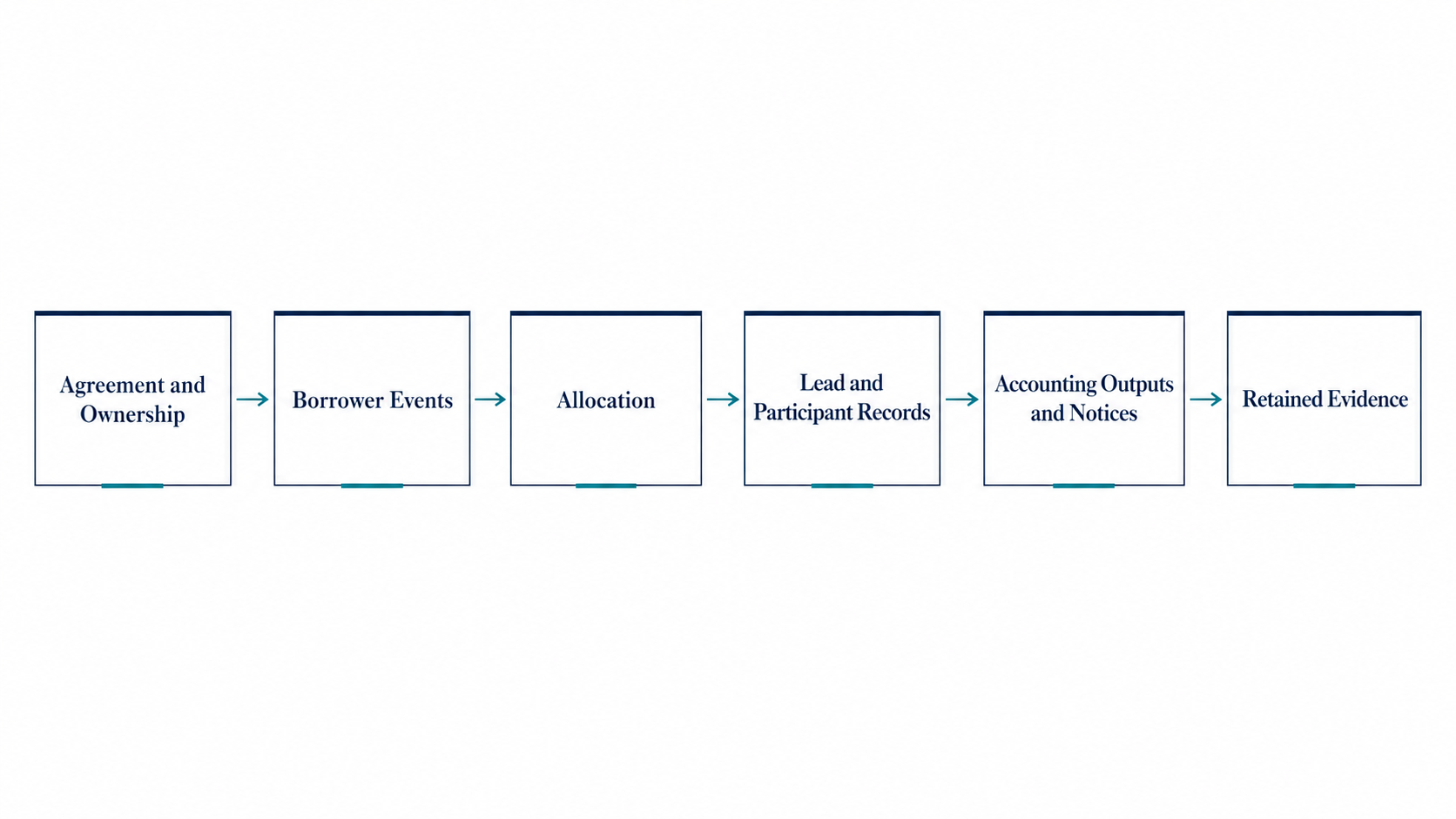
The event chain begins with the source transaction. The borrower payment must be identified and classified by component. The effective ownership must be validated. The calculation must be reviewed and approved. The result must be posted or exported to the appropriate systems. Participant remittance detail must explain the amounts. Balance records must update. Evidence must be retained.
Operational failures usually occur when one link changes before another. An ownership change may have a new effective date in one system before another system is updated. A rate reset may appear in the core before the participant record reflects it. A late reversal may be processed without the original event history. A prepayment may require special handling. A fee may be treated differently under the agreement. A cutoff timing difference may create a temporary mismatch. A participant may post only a net amount without the gross principal, interest, and fee components needed for comparison.
These are not necessarily accounting errors. They are examples of operational breaks that require investigation.
Participation reconciliation should explain exceptions, not just balances
A month-end balance comparison is necessary, but it is often too late to be the only control.
A strong participation reconciliation identifies the specific event causing a difference. The team compares gross transaction components, confirms effective ownership, identifies the source of the discrepancy, assigns responsibility, preserves evidence, documents the resolution, and records approval.
This distinction matters because not every difference means the same thing.
A timing difference may mean the event is valid but reached systems at different times. A data or mapping error may mean a transaction was incorrectly transferred or classified. An unresolved agreement or policy question may require legal, accounting, or business judgment before anyone posts a correction.
Technology can route all three situations, but it should not silently treat them as equivalent. A system that overwrites history may hide the reason a difference occurred. A better process preserves the original event, the review path, the decision, and the final outcome.
NCUA’s supervisory guidance on evaluating loan participation programs highlights the importance of properly accounting for and controlling cash-flow streams, along with controls, reporting systems, servicing responsibilities, monitoring, and agreement clarity for credit unions. Evaluating Loan Participation Programs This is credit-union supervisory guidance and should not be interpreted as a universal requirement for every institution.
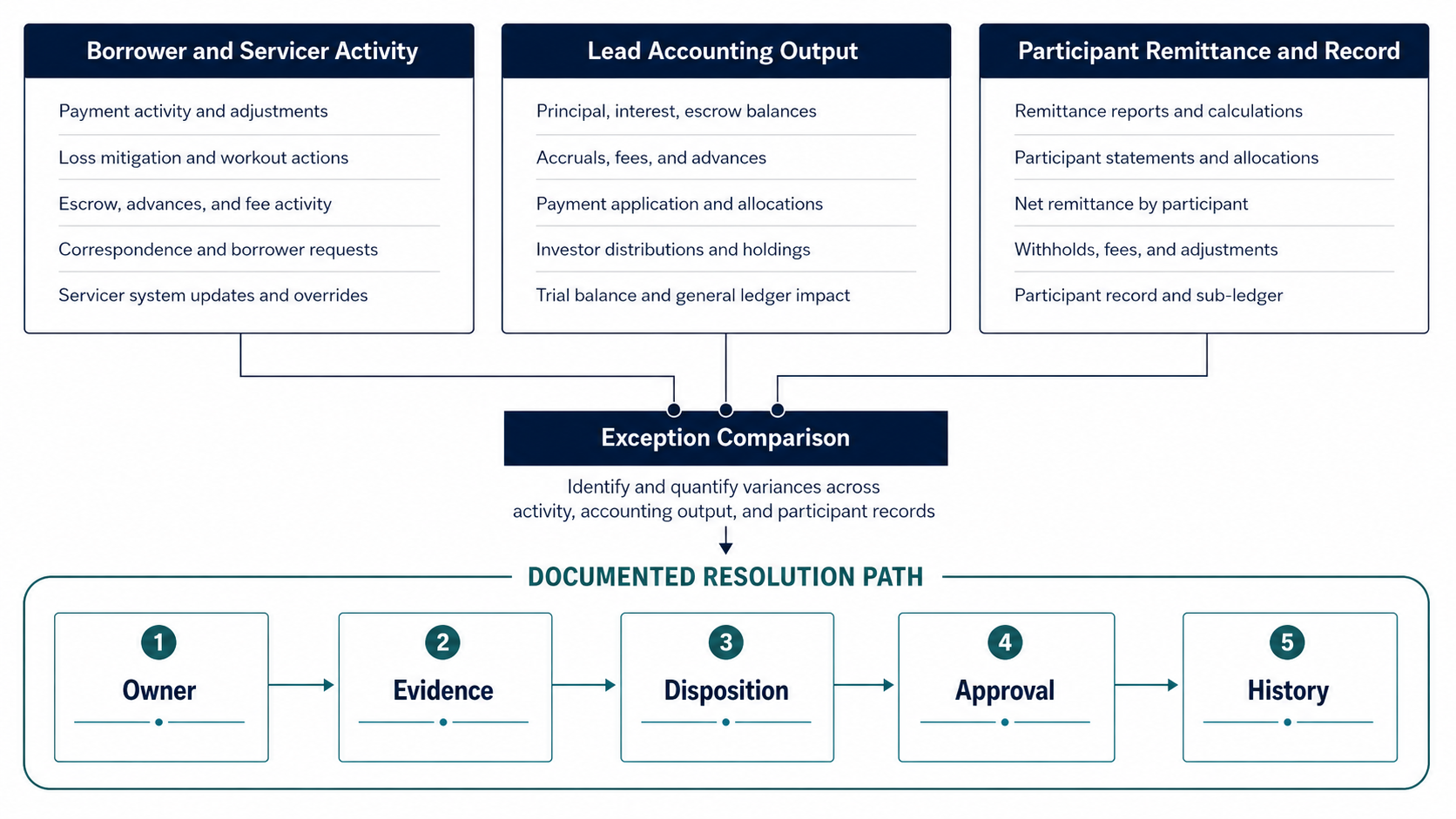
The management question is not simply whether two balances match. The stronger question is whether the institution can explain why they match and how it knows.
Evaluate what loan participation accounting software should actually do
Loan participation accounting software should be evaluated by the operating problems it solves, not by whether it replaces every existing banking system.
In many institutions, the core or loan accounting system remains the accounting system of record. A participation platform may instead provide the shared workflow layer between the lead institution and participants, helping manage ownership records, documents, notices, transactions, balances, and servicing activity. The right architecture depends on the institution’s systems, policies, and transaction volume.
A practical evaluation should consider whether the system preserves effective-dated ownership, retains gross transaction components and calculation logic, separates preparation from approval, produces participant-level detail, connects documents and notices to events, exposes exceptions without deleting history, and supports comparison with the institution’s accounting environment.
The strongest systems support traceability. A user should be able to move from a participant balance back to the allocation event, from the allocation event back to the borrower transaction, and from the transaction back to the agreement and approval record.
Public materials describe tracking loan details, documents, pro-rata shares, transactions, balances, and interest-rate changes and sending update notifications. These capabilities support workflow and record visibility, but they do not replace accounting judgment, legal analysis, underwriting, tax advice, regulatory interpretation, or institutional decision-making.
Institutions reviewing participation structures may also benefit from foundational information through the loan participation guide.
A useful software evaluation does not begin with automation alone. It begins by asking where the current process loses information: spreadsheets, email chains, manual statements, unclear ownership records, or disconnected systems.
For institutions exploring a more connected participation workflow, Participate provides information about available capabilities.
Examine the current process through the full event history
The most reliable participation processes are built around traceability. A bank or credit union should be able to examine whether any balance, remittance, or participant statement can be traced from the agreement and ownership record through the original transaction, allocation, approvals, communication, posting activity, and resolution history.
That review often reveals the real source of operational risk. The issue may not be the accounting system itself. It may be an ownership record maintained separately from the agreement, a payment detail that arrives without enough context, an unresolved exception assigned to no owner, or a process that depends on one experienced employee remembering how something was handled previously.
Loan participation accounting works when the institution-specific accounting conclusion and the operating record reinforce each other. The accounting team needs confidence that the numbers are supported. Operations needs confidence that events move through a controlled process. Participants need confidence that the information they receive matches the underlying agreement.
The goal is not simply faster posting. The goal is a defensible chain from ownership setup to reconciliation. When every event can be explained, reviewed, and supported, participation becomes a manageable operating process rather than a month-end investigation.