Loan Portfolio Risk Management: What Community Banks Should Review Now
The Office of the Comptroller of the Currency (OCC) recently updated its lending and loan portfolio risk management guidance, giving community banks a timely opportunity to review how they identify, monitor, and manage risk across the full loan lifecycle. The practical takeaway is not that banks need to adopt a specific system or process. Instead, banks should evaluate whether their risk-management framework provides appropriate visibility and control from origination through servicing, reporting, and portfolio oversight.
For institutions using participations, syndications, or whole-loan sales, that review should include shared-loan operations. Effective loan portfolio risk management depends not only on credit decisions, but also on reliable data, clear ownership, accurate reporting, reconciliation processes, and visibility after a loan changes hands. Participate’s positioning as the Loan Sales Ecosystem for financial institutions reflects this broader lifecycle approach, connecting loan-sale workflow, integrations, and post-sale participant servicing.
The OCC’s updated “Credit Risk: Lending and Loan Portfolio Risk Management” guidance, published in OCC Bulletin 2026-29, is intended to inform examiners about lending and loan portfolio risk management practices at banks of all sizes, with practices tailored to an institution’s size, complexity, and risk profile. OCC Bulletin 2026-29: Credit Risk: “Lending and Loan Portfolio Risk Management” Booklet of the Comptroller’s Handbook and Rescissions
Key Takeaways
- Loan portfolio risk management extends beyond underwriting and includes controls across the full loan lifecycle.
- Banks using participations and syndications should review shared-loan data, servicing visibility, and reporting processes.
- The OCC guidance does not require a specific technology solution, but it reinforces the importance of sound risk-management practices.
- Operational controls around ownership, reconciliation, exceptions, and reporting can strengthen portfolio oversight.
Learn how Participate supports loan sales, participations, syndications, and shared-loan servicing through a connected workflow built for financial institutions: Participate platform overview
| OCC risk-management theme | Practical question for community banks |
|---|---|
| Risk-based supervision | Are controls appropriately scaled to the bank’s size, complexity, and risk profile? |
| Risks across the loan life cycle | Can the bank demonstrate visibility from origination through servicing and payoff? |
| Portfolio risk management | Does leadership have accurate information about exposures, concentrations, and shared loans? |
| Material financial risks | Are reporting processes reliable enough to support timely decisions? |

What the OCC updated—and what it did not change
The OCC’s updated handbook focuses examiners on lending and loan portfolio risk management practices, including risk-based supervision, lifecycle risks, portfolio management, and material financial risks. The guidance also identifies loan purchases, participations, and syndications as related topics. OCC Bulletin 2026-29: Credit Risk: “Lending and Loan Portfolio Risk Management” Booklet of the Comptroller’s Handbook and Rescissions
For community banks, the important distinction is that the guidance does not prescribe a particular technology platform, participation process, or operating model. A bank’s approach should be appropriate for its own activities and risk profile.
The updated handbook is a reminder that strong portfolio management requires more than having sound underwriting policies. Banks need processes that allow them to understand how loans perform after origination, how ownership changes affect exposure, and how information moves between internal teams and external counterparties. The OCC handbook itself provides the broader supervisory framework for these considerations. OCC Comptroller’s Handbook: Lending and Loan Portfolio Risk Management
Why loan portfolio risk management includes the full loan lifecycle
A loan does not become less important to risk management after closing. In many community banks, the most complex operational challenges appear after origination.
A participation or syndication introduces additional relationships, data flows, and responsibilities. The originating bank may retain the borrower relationship while sharing exposure with other institutions. That structure can support growth and concentration management, but it also requires accurate administration.
A complete loan lifecycle view includes:
- Origination and underwriting
- Credit approval and documentation
- Distribution through participations, syndications, or sales
- Participant onboarding
- Payment and servicing administration
- Rate and fee updates
- Maturity, payoff, transfer, or workout activity
Reporting and reconciliation
For banks exploring ways to reduce concentration exposure while preserving borrower relationships, loan sell-down strategies can become part of a broader portfolio management approach. Learn more about concentration risk and sell-down strategies here: concentration risk and sell-down strategies
The overlooked risk in participations and syndications: operational control
Credit risk receives significant attention, but shared-loan activities also create operational risk. When multiple institutions own an interest in the same loan, the quality of information flow matters.
A bank may have strong underwriting and approval practices, yet still face challenges if participant balances, payment activity, ownership records, or servicing responsibilities are tracked across disconnected systems.
Participate’s loan participation approach focuses on the broader lifecycle of shared loans, including distribution, documentation, and post-sale participant servicing.
Shared data
Shared loans require consistent information. Banks should understand whether loan data, documents, ownership percentages, and transaction history are maintained in a way that allows authorized parties to work from reliable information.
Questions to consider:
- Are participant balances easily accessible?
- Are documents stored and shared securely?
- Can teams identify current ownership percentages?
- Are updates captured consistently across systems?
A shared operating view can reduce reliance on disconnected spreadsheets, emails, and manually maintained records.
Reporting and reconciliation
Reporting is a critical component of bank loan portfolio oversight. When participant activity does not align with internal records, teams need a clear process for identifying and resolving differences.
Banks should review:
- How participant statements are validated
- How payments are allocated
- How rate changes are tracked
- How discrepancies are identified and resolved
- Whether management receives timely portfolio information
The goal is not eliminating every exception. The goal is ensuring exceptions are visible, assigned, and resolved through a controlled process.
Ownership and accountability
Shared loans require clarity around responsibilities. Participation agreements may define servicing obligations, communication expectations, payment responsibilities, and decision rights.
Community banks should ask:
- Who owns each operational responsibility?
- Who approves changes?
- Who communicates updates to participants?
- Who monitors exceptions?
- Are responsibilities documented and understood?
Exception management
Manual processes often hide problems until month-end or audit review. A stronger model identifies exceptions earlier and routes them to the appropriate team.
Examples include:
- Balance mismatches
- Missing documents
- Incorrect ownership allocations
- Rate discrepancies
- Unmatched transactions
Exception-based workflows allow staff to focus attention where judgment is required.
Post-sale servicing
Loan lifecycle risk management does not end when a participation closes. Ongoing servicing visibility remains important.
Banks should consider whether they can efficiently manage:
- Principal and interest activity
- Funding requests
- Rate changes
- Fees
- Notices
- Documents
- Participant communications
Participate supports post-sale participant servicing as part of a broader loan-sales workflow rather than treating servicing as a separate administrative task.
A practical review checklist for community banks
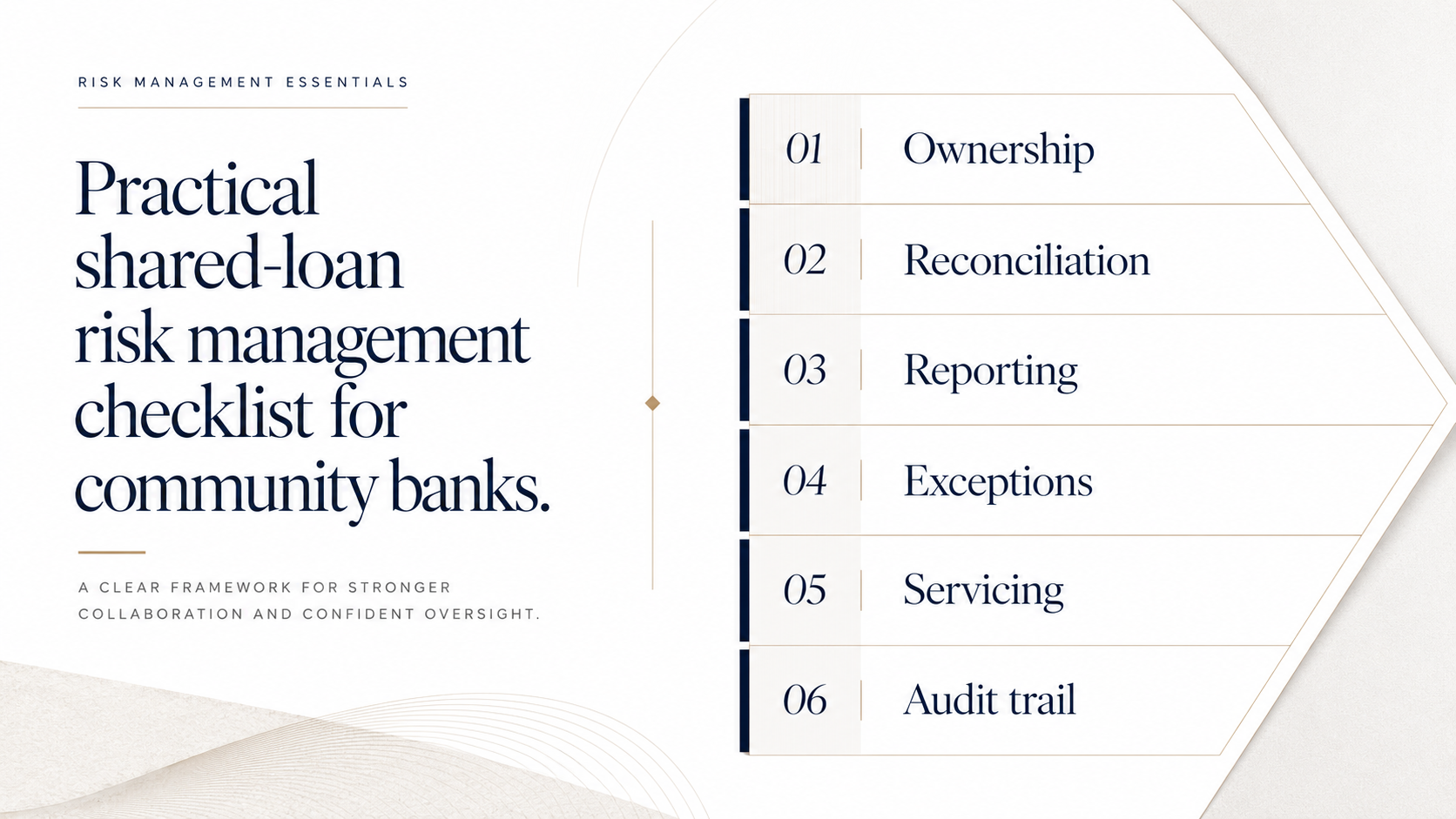
Use these questions as a starting point for reviewing loan portfolio risk management practices:
- Can we clearly identify all participated, syndicated, purchased, or sold loan positions across the portfolio?
- Do we have a consistent source for participant ownership percentages and current balances?
- Can credit, operations, finance, and leadership teams access the information they need?
- Are loan-sale and shared-loan responsibilities clearly assigned?
- Are participation agreements, documents, and notices stored in an organized and accessible manner?
- How do we reconcile participant activity with our internal records?
- Are payment allocations, fees, and rate changes tracked consistently?
- How quickly can we identify exceptions?
- Who owns resolving participant-related discrepancies?
- Can management reporting show exposure by borrower, sector, geography, or participation activity?
- Do our processes scale if participation volume increases?
- Are manual workarounds creating dependency on individual employees?
- Do our systems provide an audit trail of key activities and approvals?
- Are third-party and counterparty relationships reviewed appropriately?
How quickly can we identify exceptions?
Who owns resolving participant-related discrepancies?
Can management reporting show exposure by borrower, sector, geography, or participation activity?
Do our processes scale if participation volume increases?
Are manual workarounds creating dependency on individual employees?
Do our systems provide an audit trail of key activities and approvals?
Are third-party and counterparty relationships reviewed appropriately?
When manual processes become a portfolio risk
Spreadsheets and email remain common tools in banking operations because they are flexible and familiar. The challenge is that they can become difficult to manage as loan volume, participant relationships, and reporting requirements grow.
Disconnected records can create questions such as:
- Which spreadsheet contains the latest ownership data?
- Was the participant notified of the rate change?
- Has the payment allocation been reviewed?
- Who approved the adjustment?
- Are all teams working from the same information?
Who approved the adjustment?
Are all teams working from the same information?
Manual processes are not automatically ineffective. However, banks should periodically evaluate whether those processes provide the visibility, consistency, and documentation needed for their current operating model.
Workflow automation can help organize information, reduce repetitive tasks, and improve consistency. It does not replace credit judgment, policy decisions, or regulatory responsibility.
How technology can support risk management without replacing judgment
Technology should support—not replace—the expertise of bankers.
A well-designed loan operations platform can help institutions improve visibility by connecting activities that are often separated across systems and teams. Automation can assist with workflow, reporting, document management, notifications, and reconciliation processes.
However, technology does not replace:
- Underwriting decisions
- Credit approval
- Board oversight
- Risk appetite decisions
- Regulatory judgment
- Legal review
Participate is designed as a connected operating layer that complements existing lending and core systems rather than replacing them.
For banks evaluating workflow improvements, Participate provides capabilities for loan participation, syndication, and post-sale servicing workflows: loan participation guide
FAQ
What is loan portfolio risk management?
Loan portfolio risk management is the process banks use to identify, measure, monitor, and control risks across their lending activities. It includes underwriting, portfolio oversight, concentration management, servicing practices, reporting, and lifecycle controls.
Does the OCC guidance require banks to use loan participation software?
No. The OCC guidance does not require a specific technology solution. Banks should use risk-management practices appropriate for their size, complexity, and risk profile. Technology may support stronger visibility and operational consistency.
What risks should banks monitor after selling or participating in a loan?
Banks should monitor operational and credit-related risks, including accurate balances, ownership records, payment activity, documentation, participant communications, servicing responsibilities, and ongoing portfolio exposure.
How can a community bank improve shared-loan reporting?
Banks can improve shared-loan reporting by standardizing data sources, clarifying ownership of reporting responsibilities, automating repetitive processes where appropriate, and ensuring teams have access to reliable information throughout the loan lifecycle.
Conclusion
The answer to the question “What should community banks review now?” is straightforward: review risk controls across the entire loan lifecycle.
The OCC’s updated loan portfolio risk management guidance reinforces the importance of sound lending practices, appropriate oversight, and controls that match each institution’s risk profile. For banks using participations, syndications, and loan sales, that means looking beyond origination and evaluating the operational framework that supports shared loans after closing.
A strong approach combines credit discipline with reliable data, clear accountability, effective reconciliation, and ongoing servicing visibility. Participate helps financial institutions connect these activities through loan-sale workflow automation and post-sale participant servicing, while institutions remain responsible for underwriting, governance, and regulatory obligations.
To explore how Participate can support loan sales, participations, syndications, and shared-loan servicing workflows, visit Participate